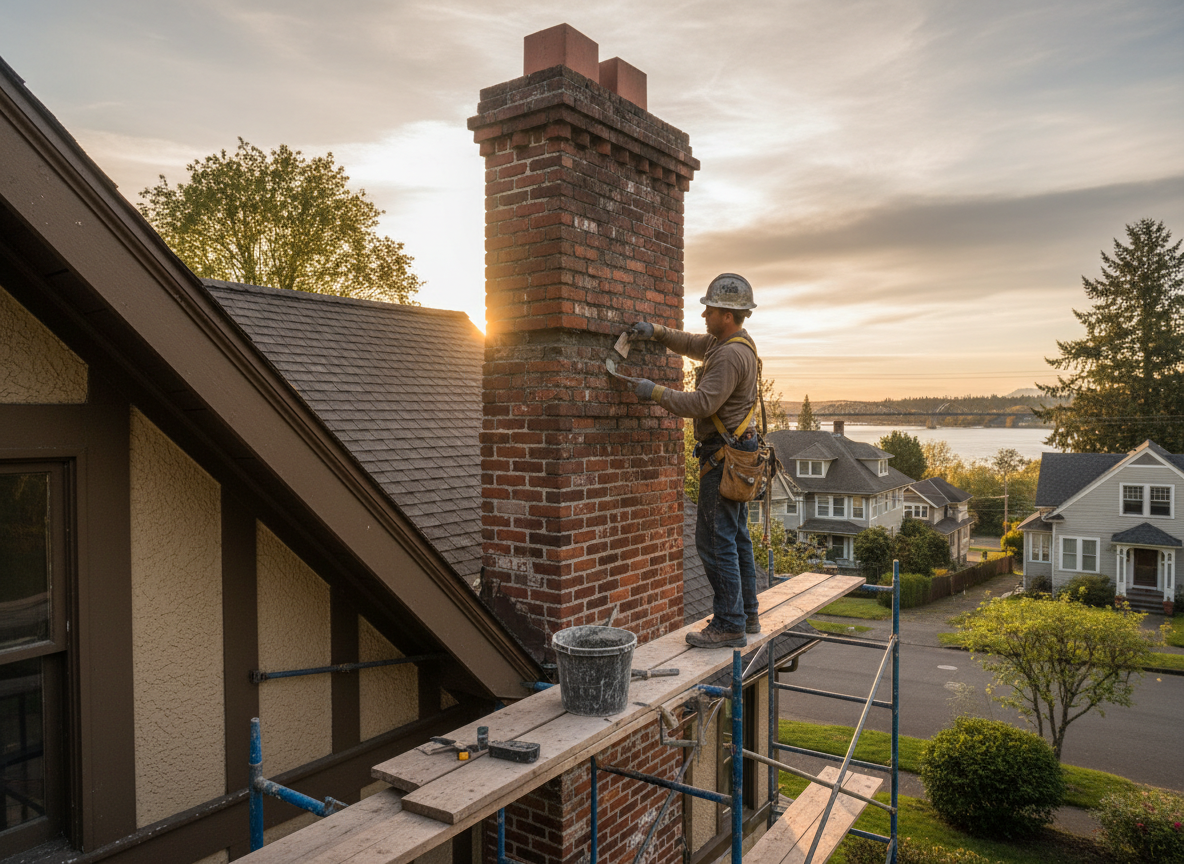
Mortar joints in Milwaukie chimneys take constant abuse from the region's mild wet winters. Water soaks into hairline cracks, freezes during rare cold snaps, and pushes bricks apart. In neighborhoods like Downtown Milwaukie and Hector Campbell, many homes built before 1950 still have original lime-based mortar that has turned soft and powdery. We remove the failed material to a minimum depth of three-quarters of an inch, then tuck-point with a pre-mixed refractory mortar formulated for exterior exposure rather than standard masonry cement.
Homes near the Willamette River and Milwaukie Riverfront Park sit on soil that stays damp much of the year. That persistent moisture travels up through the foundation and into the chimney base, accelerating deterioration at the roof line. We always check the flashing and crown condition on the same visit because a single failed joint often signals water entry points that standard repointing alone will not solve. In Ardenwald and Island Station, tree cover keeps chimneys shaded, so they dry slowly after rain and stay vulnerable longer than chimneys in sunnier parts of Portland.
Code compliance in Clackamas County requires that any chimney work visible from the exterior maintain the original clearance to combustibles and use materials rated for the appliance type. We never use caulk or exterior-grade silicone in mortar joints because those products trap moisture and cause faster brick spalling. After repointing we leave the work untouched for 48 hours so the mortar can cure before any rain, which is common even in summer.
Edge cases we see regularly include chimneys that lean slightly from decades of soil movement along the river corridor. In those situations we document the lean with photos before starting and advise the homeowner whether mortar repair is sufficient or if a full rebuild is needed. We also inspect the smoke chamber and flue tile condition because mortar failure at the top often means the interior joints have failed as well.
Technician insight
In Milwaukie the thing that catches most people out with chimney mortar repair is how the constant damp from the Willamette River and heavy winter rain keeps the masonry wet for weeks. Homeowners in Ardenwald and Island Station often point the joints themselves with regular mortar that never cures properly and then flakes off within a year. We always check the soil grade around the foundation because water wicking up from below ruins new work faster than weather alone.
Cracked Joints on 1940s Chimney in Ardenwald
A homeowner noticed white powder on the bricks after several weeks of rain. We found soft lime mortar and open joints on the south face where the chimney stayed shaded by trees. We removed the failed material, repointed with refractory mortar, and corrected a small gap in the flashing that had been letting water behind the bricks. The chimney has stayed dry through the following winter with no new cracking.
How it works
- 1
Site Assessment
We inspect the chimney from roof to foundation, noting joint condition, flashing, and any lean, then photograph everything for the homeowner.
- 2
Joint Removal
Failed mortar is cut out to sound material without damaging brick edges, using hand tools on older homes to avoid cracking surrounding masonry.
- 3
Repointing
Refractory mortar is packed into the joints in layers, tooled to match the original profile, and protected from direct rain during the initial cure.
- 4
Final Check
We return after 48 hours to verify cure, test draft if needed, and confirm no new water entry points remain at the crown or flashing.
Pricing
Cost depends on chimney height, number of joints, and whether scaffolding or roof access is required; we provide an upfront quote after inspection.